When organisers ask about event microphone hire in Singapore, the first figure they name is often a type: four lapels, or six handhelds. The more useful question is how many people need to be heard at the same time, and how they will stand, sit or move. Handheld, lapel or headset — the microphones are charged by how many you need, whatever the type.
This guide is for coordinators, HR and comms teams, schools and associations planning a conference, panel, AGM, award ceremony or school programme. PROLIVE’s audio services cover the microphones, a digital mixing desk and an operator who listens throughout the day, so the people in the hall — and anyone on a stream — can follow every word.
Start with the programme, not the equipment
A run-of-show is the best starting point, even as a draft. Look at each segment and ask:
- How many people will speak at once?
- Will they stay at a lectern, sit on a panel, or walk the stage?
- Is there an emcee or a moderator?
- Will there be questions from the floor, or recipients coming up to speak?
The answers give you a working total: one microphone for each person who must be ready to talk without waiting for a handoff, plus what you need for the emcee and for Q&A. A spare microphone, and spare batteries, belong in that plan as well.
Handheld, lapel or headset — which suits which moment
The type of microphone should follow how the person will use it. It does not change how the microphones are quoted.
Handheld microphones suit an emcee who is not at the lectern, a question from the floor, and any moment when a microphone needs to move from one person to the next.
Lapel microphones (also called lavaliers) clip to a jacket, blouse or collar. They leave the speaker’s hands free, which is why they are a common choice for a keynote, a formal address or a seated panellist. They need a clean place to sit on the clothing, and a little time to fit before the person goes on.
Headset microphones sit closer to the mouth and stay in place when the speaker moves. They are useful for a presenter or emcee who walks a great deal, or who needs a consistent level while their hands are busy with a clicker or a script.
A rostrum or gooseneck microphone is often fixed at the lectern. At an award ceremony or a school prize presentation, speakers usually step up to it in turn, so they do not each need their own microphone.
For most corporate and school programmes, a mix is normal: a rostrum or gooseneck microphone at the lectern, a lapel or headset for the people who stay in one role, and a handheld if someone will speak from the floor.
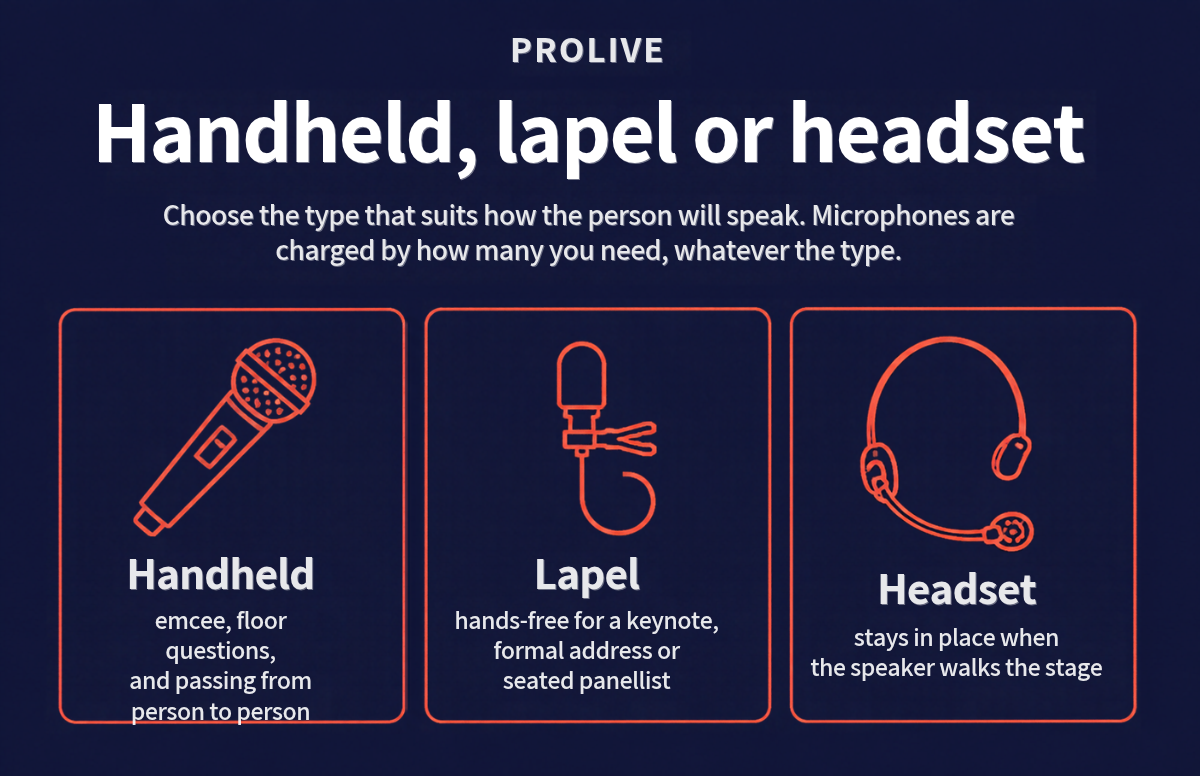
Handheld, lapel or headset: choose the type that suits how the person will speak. Microphones are charged by how many you need, whatever the type.
Typical counts for common programmes
These are starting points for a conversation, not a quotation. Once we know the rundown and the room, we will confirm the actual number.
A keynote or single address. Plan one microphone for the speaker (often a lapel, or a rostrum or gooseneck microphone), one for the emcee, and one or two handhelds if there will be questions from the floor. Keep a spare.
A panel. Ideally, give the moderator and each panellist their own microphone so nobody waits for a handoff; panellists can share if needed. A panel of four plus a moderator is then five open microphones. Add handhelds for audience questions if the format needs them.
An award ceremony. Speakers — presenters, citation readers and recipients — usually speak at a rostrum or gooseneck microphone, so there is no need to pass a handheld or give each person their own. Plan that rostrum or gooseneck microphone, a microphone for the emcee, a handheld only if someone will speak from the floor, and a spare.
A school prize presentation or graduation. The principal, guest of honour, citation readers and recipients usually speak at a rostrum or gooseneck microphone in turn. Plan that microphone, a microphone for the emcee, a handheld only if someone will speak from the floor, and a spare.
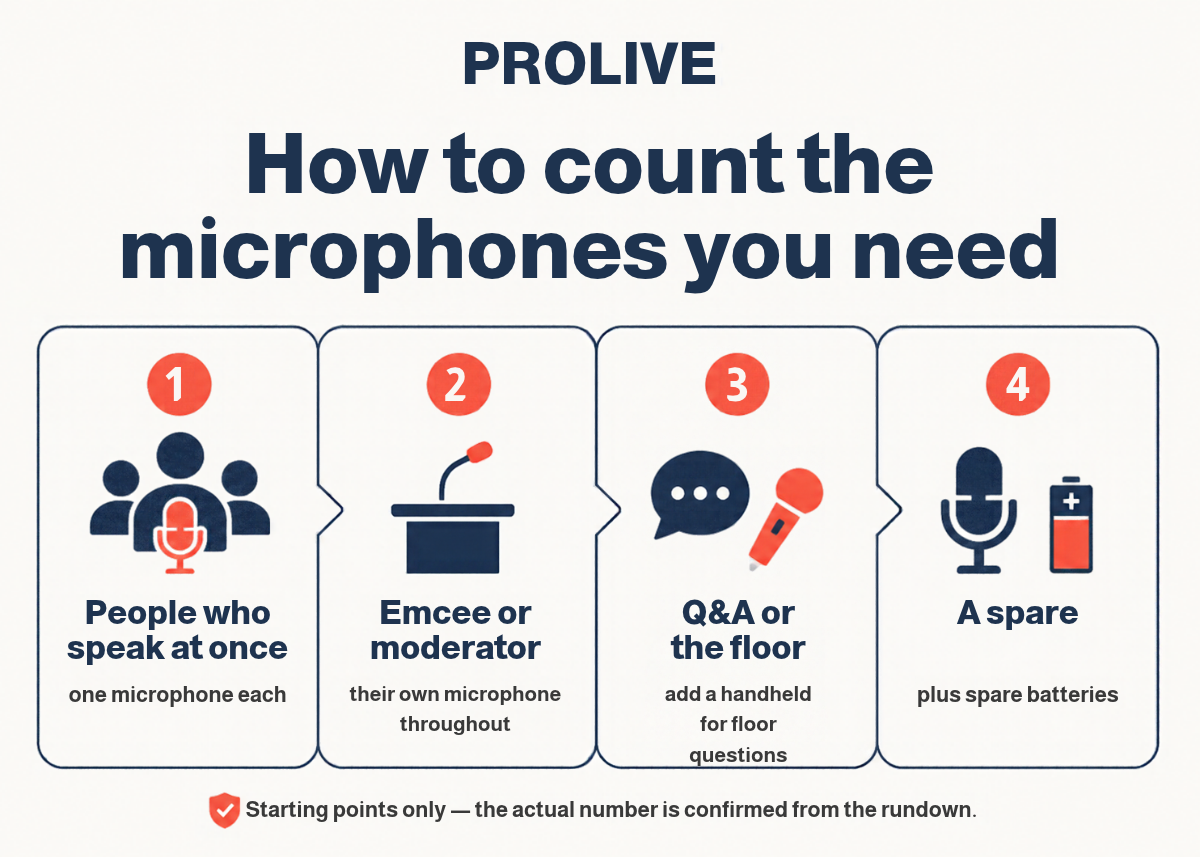
How to count the microphones you need: everyone who speaks at once, the emcee or moderator, a handheld for floor questions, and a spare.
The desk that ties it together
The microphones only work as a programme if someone is mixing them. PROLIVE operates a digital desk for the day — usually the Allen & Heath SQ5 — so levels stay comfortable as the rundown moves from one person to the next. The audience in the hall is the first audience. If the event is also being livestreamed, the stream often needs its own careful mix. It is not always the same as the hall mix.
For a hybrid event, mix-minus is standard, so a remote speaker hears the room clearly and does not hear themselves back. The hybrid page explains how remote speakers join; the point here is that the microphone plan and the desk plan belong together. We test every microphone and both mixes — the hall and, if there is one, the stream — before your guests arrive. During the programme, someone is always listening.
A practical checklist
- Count how many people must be ready to speak at once, including the emcee or moderator.
- Choose handheld, lapel or headset from how each person will stand, sit or move — the type does not change the charge.
- Add a handheld only if someone will speak from the floor.
- Include a spare microphone and spare batteries in the plan.
- Tell the crew if the event is hall-only, a livestream, or a hybrid session, so the desk can be set accordingly.
Frequently asked questions
Are handheld, lapel and headset microphones charged differently?
No. Microphones are quoted by the number you need, whatever the type. Choose the style that suits the segment.
How many microphones does a panel need?
Ideally, give the moderator and each panellist their own microphone so nobody waits for a handoff; panellists can share if needed. Add handhelds if you want questions from the floor, and a spare whenever several people have microphones at once.
Do we need a different setup if we are livestreaming or running a hybrid event?
The people in the room still need a clear hall mix, and a livestream usually needs its own mix as well. On a hybrid event, mix-minus is standard; you can read more on our hybrid events page. Mention the format when you book.
Can you work with the venue’s sound system?
Yes. Many hotel ballrooms and school halls already have loudspeakers. We can work with the house system, or plan the hall sound as part of the same audio booking. Tell us what the room already has.
Once you know who must be heard, the number of microphones — and the type of each one — usually falls into place.
Not sure which service you need? WhatsApp us and we’ll help you work it out.
WhatsApp: +65 9452 0491